When it comes to handling long, heavy or bulky materials, a conventional forklift isn’t always the most efficient solution.
Timber, steel, aluminium profiles, pipes, sheet materials and other long loads can be difficult to manoeuvre with a standard counterbalance forklift, particularly where warehouse or yard space is limited.
This is where sideloaders come in…
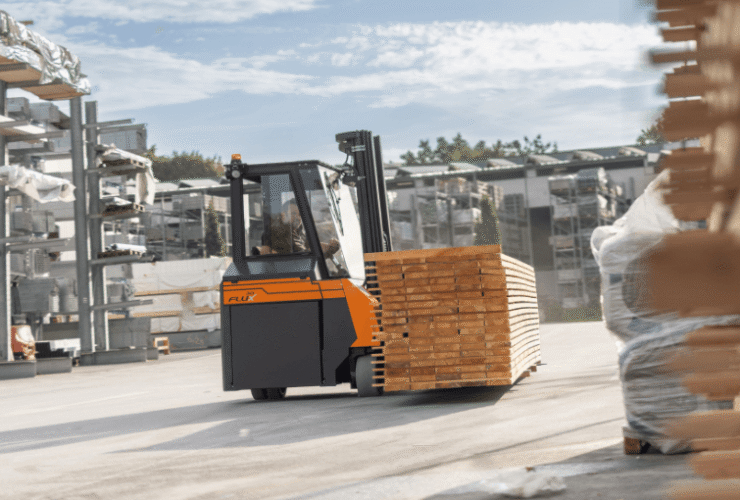
Unlike traditional forklifts that carry the load in front of the truck, a sideloader picks up and transports materials from the side. This allows long loads to travel lengthways with the vehicle, significantly reducing the space required to move through aisles and storage areas.
However, not all sideloaders operate in the same way.
Depending on your application, you may encounter 2-way sideloaders, 4-way sideloaders and multidirectional sideloaders. Understanding the differences between them can help you choose the right material handling solution for your operation.
What Is a Sideloader?
A sideloader is a specialist forklift designed primarily for transporting long, bulky and oversized loads. Most commonly used in the timer, steel, aluminium, plastics, manufacturing and building materials industries.
Rather than positioning the forks at the front of the truck, the mast and forks are located along the side. This means the operator can approach the load sideways, lift it and retract it ready for transportation.
This design provides several advantages when handling long materials, including greater stability, easier handling of long awkward loads, and improved utilisation of warehouse space.
The key difference between the various types of sideloader is how the truck can travel and steer.
2-Way Sideloaders
The truck primarily travels forwards and backwards along its normal direction of travel, with the load positioned sideways on the load bed.
This makes 2-way machines particularly well suited to operations where materials are moved along relatively straightforward routes between storage locations.
Where Are 2-Way Sideloaders Used?
2-way sideloaders can be particularly effective in outdoor yards with long travelling distances and long-load storage areas, where there is sufficient space for the truck to manoeuvre. Their simple travel pattern can make them a practical solution where multidirectional manoeuvrability isn’t required.
Certain sideloaders can also be equipped with larger tyres and chassis configurations designed for uneven outdoor surfaces.
For businesses predominantly moving materials around a large external yard, a traditional sideloader can therefore remain an extremely effective option.
4-Way Sideloaders
A 4-way sideloader adds another level of flexibility. As the name suggests, the truck can travel in multiple principal directions rather than simply forwards and backwards.
By changing the orientation of the wheels, the machine can move longitudinally or sideways, allowing operators to position long loads within significantly tighter spaces.
This makes 4-way trucks particularly useful within warehouses where aisle width and storage density are important considerations.
Where Are 4-Way Sideloaders Used?
4-way sideloaders are commonly used for handling materials such as:
- Timber
- Aluminium profiles
- Plastic profiles
- Steel sections
- Pipes
- Building materials
- Long palletised products
They can be especially useful where a truck needs to transport a long load along an aisle before changing direction to position it into racking.
Some HUBTEX 4-way models are specifically designed for straightforward indoor applications where businesses require a compact and economical method of transporting long goods.
Multidirectional Sideloaders
For operations requiring maximum manoeuvrability, a multidirectional sideloader provides the greatest flexibility.
These trucks use advanced steering systems that allow them to travel in several directions, including forwards, backwards, sideways and diagonally.
Depending on the machine and steering configuration, operators can transition between different travel modes and perform extremely tight manoeuvres.
This allows a multidirectional sideloader to transport long materials through areas that would be extremely difficult to navigate with a conventional forklift.
How Does a Multidirectional Sideloader Work?
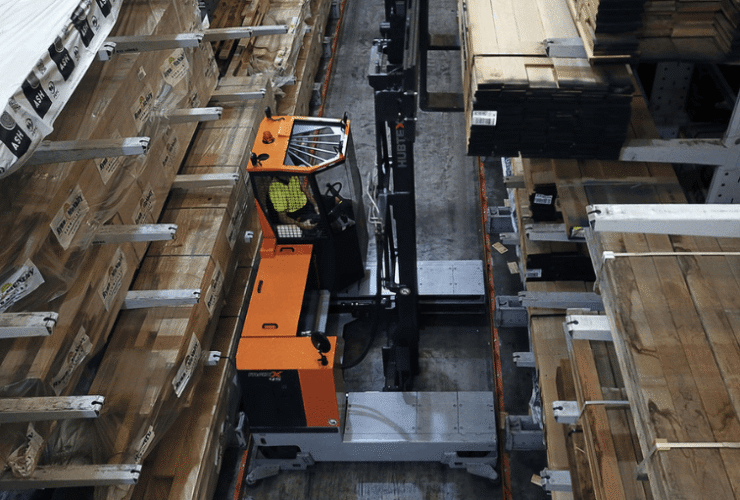
The wheels can rotate to different steering positions depending on the required direction of travel. For example, the operator might collect a long bundle of timber before travelling sideways along a narrow warehouse aisle. When reaching a more open area, the steering mode can be changed so the truck travels forwards like a conventional forklift.
The ability to change direction without needing a large turning area is one of the major advantages of multidirectional equipment.
HUBTEX multidirectional trucks are specifically designed for handling long loads in narrow aisles and can be configured for a wide variety of indoor, outdoor and mixed applications. Multidirectional machines can provide significant operational benefits such as greater manoeuvrability, narrower aisles and both indoor and outdoor operation.
2-Way vs 4-Way vs Multidirectional Sideloaders
Although the terms are sometimes used interchangeably within the materials handling industry, the key consideration is the degree of steering flexibility required by the application.
A 2-way sideloader is typically best suited to straightforward transport routes, particularly within outdoor yards where there is plenty of manoeuvring space.
A 4-way sideloader introduces sideways travel, making it easier to handle long materials within warehouse aisles and confined storage areas.
A multidirectional sideloader provides the greatest freedom of movement, allowing the machine to travel in several directions and negotiate particularly tight or complex warehouse layouts.
Which Type of Sideloader Is Right for Your Business?
There’s not a one size fits all solution when it comes to sideloaders. Before selecting a truck, it’s important to assess the complete material flow throughout your facility. Consider where loads arrive, how they are unloaded, where they are stored, the routes they travel and how frequently they need to be moved.
A properly specified sideloader can not only improve material handling efficiency but can also help businesses make considerably better use of their available storage space.
Find the Right Sideloader with HUBTEX Australia
HUBTEX specialises in material handling solutions for long, heavy and bulky loads, with sideloaders and multidirectional forklifts available for a wide variety of applications.
From straightforward long-load handling to demanding narrow-aisle warehouse operations, HUBTEX equipment can be configured around the specific requirements of your site, materials and workflow.
Our specialists can assess your operation and recommend a material handling solution designed around your load dimensions, storage environment and operational requirements.
Speak to HUBTEX Australia today to discuss the right sideloader for your application.